The Western Landscape Shaping Human Outlook
The Power of the Dog (Thomas Savage Edition)The Western Landscape Shaping Human Outlook is the idea that western terrain does not merely surround human lives: it helps determine their conditions, fortunes, and ways of seeing. In Thomas Savage’s fiction, the landscape can be loved and tested, but it can also impose costs that affection cannot undo. It is both a material force in people’s lives and a field through which they interpret the world. The broad horizon may foster openness, while a particular hillside can become a test of perception and a sign of who understands the country.
Landscape as a Force in Human Lives
In The Pass, the prairie and the formidable pass beside it shape the destinies of ranchers and Scandinavian farmers who settle nearby. Savage’s landscape description is not decorative scenery set behind an independent human drama: the terrain governs the inhabitants’ fortunes. Its changing conditions matter to their lives, and the people love the place even as they test themselves against its spring storms and baking drought. The attachment is therefore not simple comfort. The country offers beauty and demands endurance, binding affection to exposure and risk.
The tension becomes stark when a character freezes to death on a trapline. His young wife connects the loss to the prairie he loved: the place that gave meaning to his life also contributed to its end. That reversal makes landscape more than an emblem of freedom or a picturesque home. Loving a place does not protect its inhabitants from its severity. Savage’s western fiction, as the critical account describes it, recognizes that hard country can kill in more than one way; the trapline death makes the landscape’s power personal and irreversible.
The Western Horizon and Human Outlook
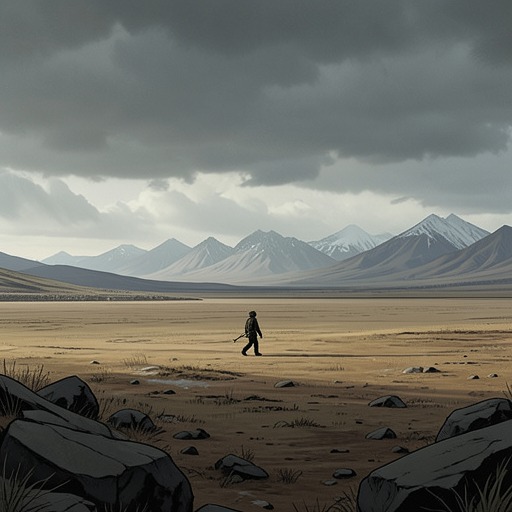
Savage articulated the idea directly in an interview, arguing that landscape shapes people and that Westerners differ partly because of the country they inhabit. He associated the movement west from Chicago with a sense of openness, linking that outlook to the experience of looking at the Rocky Mountains or across an equally vast horizon. In his account, such scale makes it difficult to keep Europe, neighbors, or other distant reference points at the center of one’s imagination. The claim is not simply that western scenery influences mood: the size of the visible world alters a person’s sense of what matters and how far thought can reach.
That argument also has a biographical dimension. A critical reading suggests that, while living in the tighter confines of the East, Savage may have recreated the western country he came from for personal as well as literary reasons. His longing for the West is thus connected to the act of writing it, but the fiction does not reduce the landscape to an object of nostalgia. The prairie remains capable of imposing hardship, and the memory of home includes both attachment and danger. The outlook shaped by the West is therefore double: it can be open to vastness and deeply sympathetic to place without mistaking love for safety.
Seeing the Landscape in The Power of the Dog
In The Power of the Dog, landscape shapes outlook through a more intimate test of sight. A hillside near the ranch house, marked by rock outcroppings, slope, and sagebrush, forms the image of a running dog. Phil Burbank treats the ability to see that figure as evidence of intelligence and perception. He reads the landscape as something that can disclose a pattern to an attentive observer, and the image supports his belief in his own unusual sensitivity. Yet his test also makes perception a judgment of other people: what they see, or fail to see, becomes part of how he measures them.
The scene with Peter Gordon complicates Phil’s claim to special vision. During their conversation, Phil asks what can be seen on the hillside, and Peter identifies a running dog. Peter says he saw it when he first arrived. The recognition is therefore not Phil’s alone, even though he has made the image part of his private standard for judging perception. Earlier, Phil’s mentor Bronco Henry had trained him to use his eyes; here, the landscape becomes the subject of that lesson and a means of testing whether its pattern can be recognized by someone else. It is not only scenery to be looked at but a feature that acquires significance through attention, memory, and comparison between observers.
The contrast with George Burbank is especially pointed: the critical account says that he cannot see the dog. The same hillside thus does not produce a single, shared meaning for everyone who looks at it. Phil’s interpretation turns the visible land into a hierarchy of insight, while Peter’s independent recognition unsettles the exclusivity of that claim. The episode gives the landscape an active role in human relations: it furnishes an image, but characters also use that image to judge one another.
The Landscape Novel and Its Changing Place
Savage’s treatment of place belongs to a wider American landscape-fiction tradition, in which setting drives stories and controls the lives of characters rather than serving as background alone. The critical account situates The Pass, Lona Hanson, and, to some extent, The Power of the Dog within a late phase of that tradition’s golden age, roughly the first half of the twentieth century. It compares this mode with the work of writers including Willa Cather, Marjorie Kinnan Rawlings, William Faulkner, and John Steinbeck, whose fiction likewise carries a strong sense of place. In this account, landscape-focused writing is suited to depicting America’s distinct regions, the pioneer ethos, and the drive of capitalist democracy in pursuit of resources.
The account also identifies a historical change in how fiction can position people against the land. By 1948, with Norman Mailer’s The Naked and the Dead, characters could be presented in an adversarial and manipulative relation to raw country; the older landscape novel was then disappearing. That contrast clarifies the particular force of Savage’s approach: the land in his fiction is not simply an opponent to be mastered, nor a neutral stage for human action. Its conditions organize the lives of those who inhabit it, while its forms invite interpretation. The Western landscape shapes human outlook because it is at once lived environment, source of attachment and danger, and a presence against which people discover the limits of their control and the reach of their perception.